Human Provenance
What if every object carried the story of the humans who made it — and every hand that touched it added a layer?
You know the label. Made in Germany. Made in Japan. Made in China. It tells you where something comes from. But it never tells you who.
Who designed this? Who built it? Who sat in a room and argued about whether it should work this way or that way? Who cared enough to stay late and get it right?
We know the place. We never know the people.
The hypothesis
If people can see who stands behind the things they use, read, or touch — it changes their relationship to those things. Anonymity makes things disposable. Provenance gives them meaning back.
Made in → Made by
Two words. One shift. From where to who. From place to people. From geography to humanity.
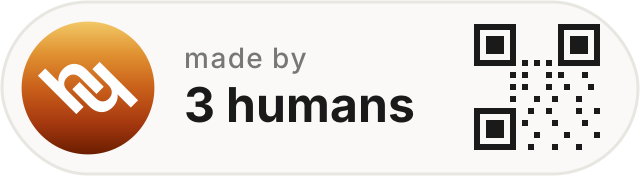
A small badge — a logo, a line of text, a QR code — that says: made by 3 humans. Not a credits page. Not a copyright notice. A warm, living reference to the people who sat around the fire when this was made.
Scan it, click it, and you meet them. Not their LinkedIn profiles. Not their job titles. The humans. What they contributed. Why they cared.
A first sketch of what this could look like:
Why now
We live in a moment where, for the first time, it's unclear whether a text, an image, or a piece of code was made by a human or a machine. Everything gets faster, cheaper, more efficient — and more anonymous.
Every friction we remove also removes a layer of meaning. The handwritten letter means more than the WhatsApp message — not because the content is better, but because someone took the trouble. The trouble is the meaning.
Made by humans is not anti-AI. It's a conscious marker that says: real people were here. They sat together, thought, argued, laughed. This wasn't generated — it was lived.
How it works
1. Create
You've made something — together with others, or on your own. You create a provenance entry: a title, the people involved, and optionally a short story of how it came to be.
2. Generate
The system creates a unique ID and different formats for embedding: a visual badge, a link, a QR code. Each one carries the same information — who stands behind this thing.
3. Embed
Place it wherever the thing lives. In your blog. On your website. On a product. As a sticker on a wall. As a label sewn into a jacket.
4. Reveal
Someone scans the code or clicks the badge. The humans behind it become visible. Not as a popup. Not as a credits page. More like turning an object over and discovering the potter's stamp on the bottom.
Beyond creation — living provenance
What happens when provenance doesn't end with the creator but lives on with the object?
Imagine you sell your bicycle. Or give away your favorite jacket. Today, that's a transaction — thing changes owner, done. With human provenance, it becomes a continuation: the object carries its history with it.
You rode that bicycle for three years — your fingerprint stays part of its story. The next person rides it through a different city — a new layer is added. The bicycle doesn't become used. It becomes richer.
Like tree rings. Every human who touches an object becomes a ring. The object grows more valuable with each person — not less. That's the exact opposite of depreciation.
Imagine walking into a second-hand shop, scanning the QR code on a chair, and reading: Built by Maria in a carpentry workshop in Freiburg, 2019. Four years in someone's living room in Berlin, where they drank coffee every morning.
Suddenly that's not a used chair. That's a chair with a story. And you're the next page.
Digital and physical
In the digital world, the badge is an image — embeddable anywhere. Click it and the humans reveal themselves within the context. No redirect. A deepening, not a departure.
In the physical world, it's a QR code. On a sticker, a label, an engraving. Scan it and you land on a warm, minimal page that introduces you to the humans behind this object.
The same provenance entry powers both. One story. Two worlds.
Open questions
- How do you prevent misuse — people claiming involvement in things they didn't contribute to?
- How does consent work? Every person listed must confirm they want to be visible.
- Should provenance be possible anonymously? "3 humans made this" — without names, but with warmth?
- What happens when someone withdraws their visibility?
- Could this become a new quality standard — objects with long provenance chains being more desirable, not less?
- How small can a QR code be and still scan reliably?
Get involved
This experiment is forming. If you've ever wondered who made the things around you — or if you've made something and wished your contribution was visible — we want to hear from you.
Reach out →